
26 December 2025
By Chris "The Drone Geek" Fravel
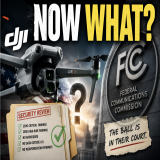
The news arrived not with a bang, but with the cold, impersonal finality of a social media post. On December 22, 2025, a day earlier than many in the industry had braced themselves for, Federal Communications Commission (FCC) Chair Brendan Carr took to X to announce the formal inclusion of DJI and Autel onto the “Covered List.” This move, powered by the National Defense Authorization Act (NDAA), was expected—a culmination of months, if not years, of legislative saber-rattling.
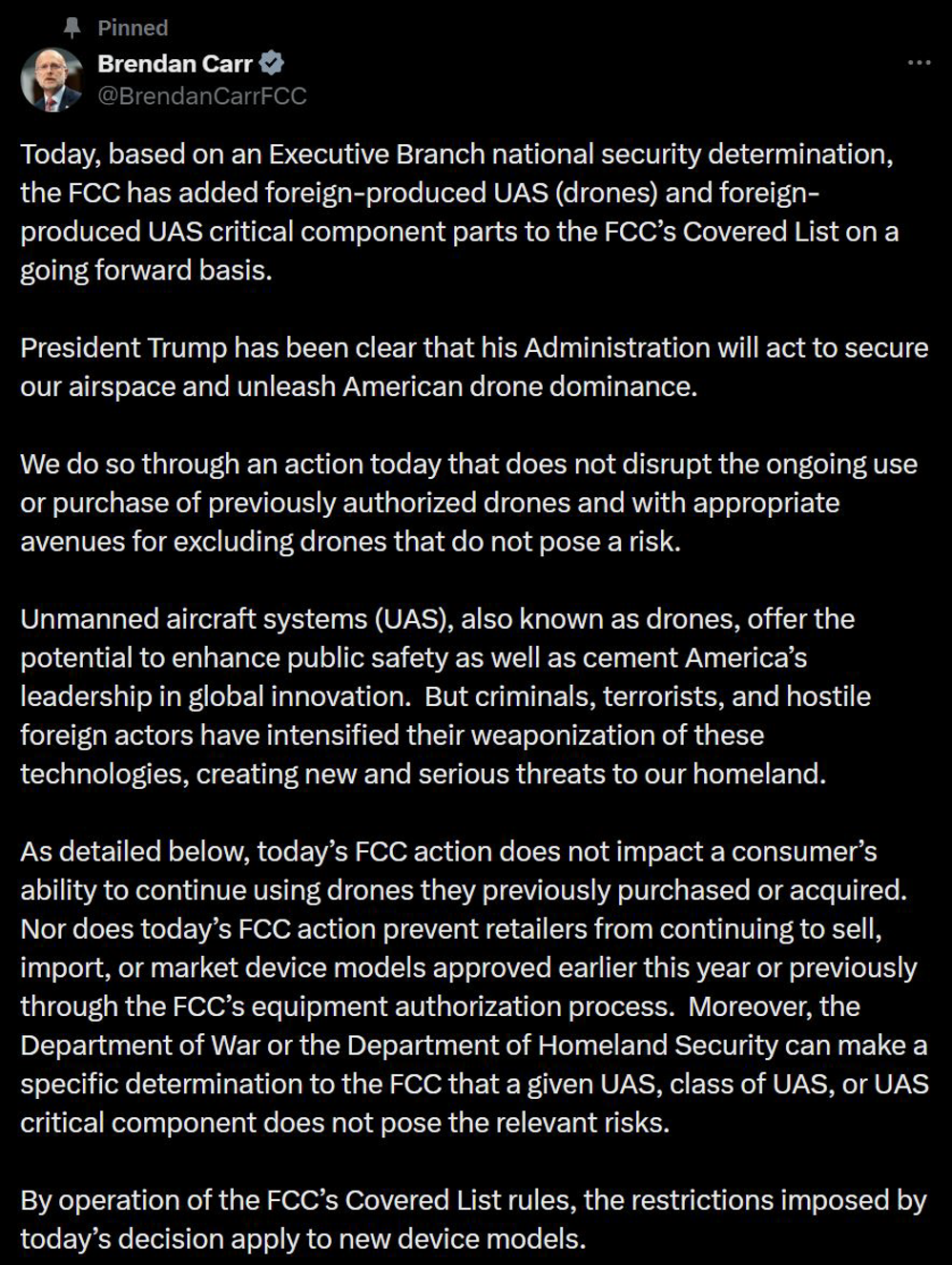
Yet, a great many of us—myself included—were blindsided by the accompanying news: the chilling, sweeping inclusion of all foreign-made drones and critical components. This broad, almost carelessly expansive stroke of a pen leaves the American drone ecosystem reeling, suddenly facing a future where our options are restricted, innovation is stifled, and the global drone supply chain is treated as a geopolitical threat—even when it involves allied nations. This is more than a ban; it’s an overreach that has cast a pall over the future of uncrewed aerial systems (UAS) in the United States, forcing us all to grapple with a new reality of severe limitation.
The Scope of the Ban
The official statement from the FCC paired with Chairman Carr’s mid-afternoon post confirmed what we had feared for DJI and Autel—a ban on future FCC approval and sale in the United States. While this aspect of the news had been widely anticipated, the devil was in the details, or, more accurately, in the scope.
The inclusion of all foreign-made drones and critical components is the clause that landed like a freight train on the community. Such a blanket statement leaves critical questions unanswered and simultaneously closes the door on vast swathes of the global market. It’s a statement so broad it suggests a fundamental misunderstanding of the drone industry’s globalized nature, or perhaps, a deliberate intention to create a US-centric island of technology with little regard for the economic and innovative consequences. The effective date, starting in 2026, gives a false sense of breathing room, but the die is cast, and the clock is ticking on a market that has thrived on international collaboration and competition.
Separating Fact from Fear
My intention is not to be a fear-monger, but rather to interpret the facts presented by the FCC's aggressive stance. Before we speculate further on the implications, it is paramount that every drone operator understands a few key things:
Your DJI drones are not illegal to fly. You can still fly anything you currently own. This ban is not a recall, and the FCC will not be deploying a personal Gestapo to confiscate existing equipment. Continue flying, having fun, and earning money with the systems you already possess.
You will still be able to purchase drones that have received FCC licensing. This includes any platform already approved for use and sale in the United States, whether released or unreleased at the time of the announcement. This means you can continue to purchase models like the Mavic 4s, Air 3Ss, Mini 5 Pros, and any other systems that have already secured their FCC approval. However, you will not be able to purchase or legally utilize any drones or components from foreign manufacturers that have not been granted this existing approval. The line in the sand is drawn based on the current FCC licensure status.
DJI is still in your corner. The company has responded to this latest announcement, making it clear that they intend to maintain a presence in the American market where possible. This includes servicing existing drones and facilitating the purchase of already-approved systems. Their commitment, despite the regulatory assault, provides a measure of stability for current owners.
The FCC could revoke existing approvals. This is the most crucial, and perhaps most alarming, point. Earlier this year, the FCC voted to grant itself the power to revoke existing approvals on any device under its jurisdiction. While they have not yet exercised this authority against existing DJI or other foreign-made drones and components, the capability is now a permanent tool in their belt. This unfounded and unwarranted overreach in the current announcement indicates a body very capable of abusing its newfound power. This possibility, though not yet a reality, is a serious threat that the community must be aware of.
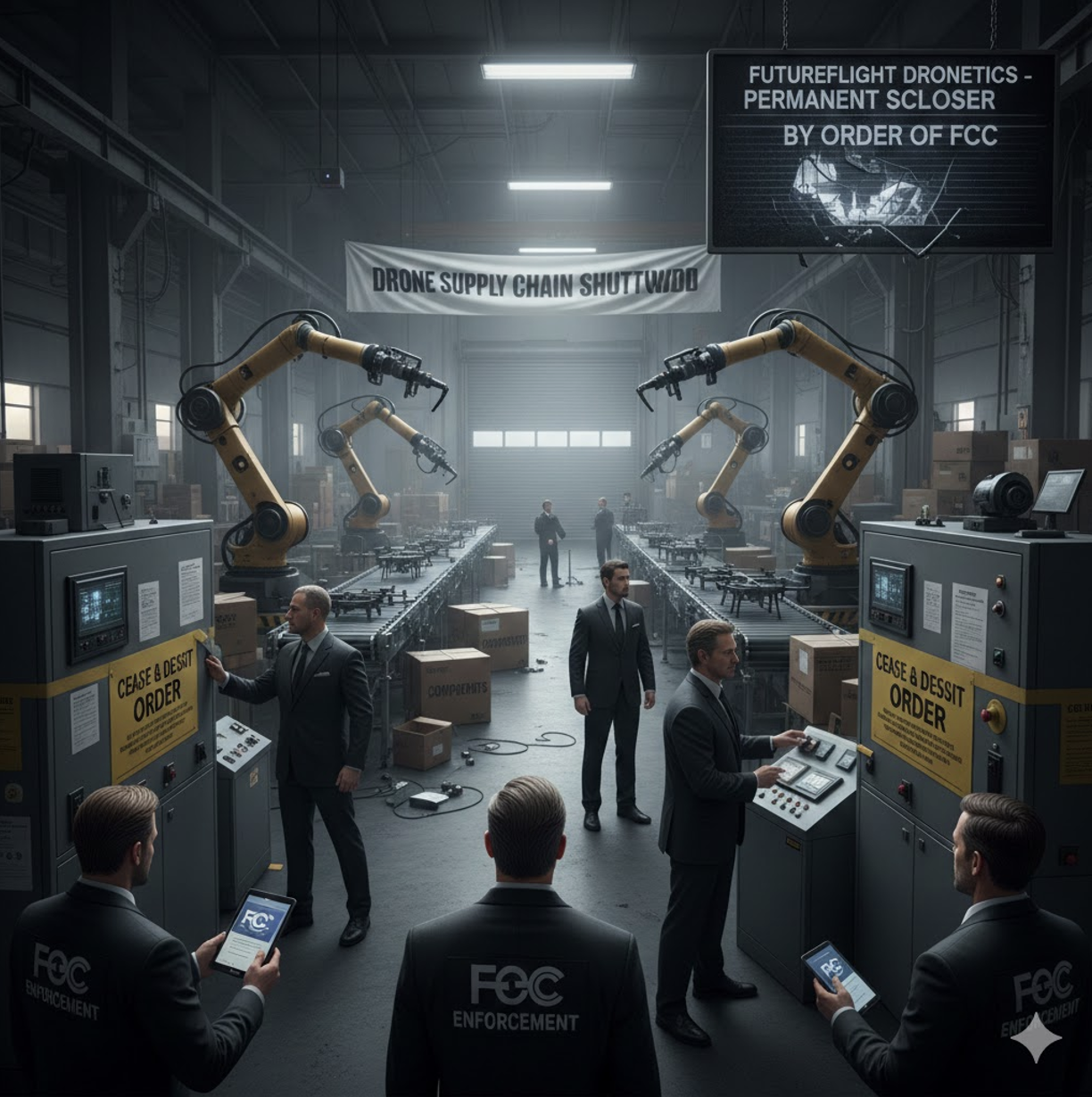
The immediate, practical consequence of this policy is a severe restriction on consumer choice and professional supply chains. Effective 2026, the door is closed on all unapproved drones or critical components from companies in foreign countries.
This extends far beyond the prebuilt aircraft from giants like DJI and Autel. It encompasses the entire ecosystem of components that fuel the dynamic FPV and custom UAS markets. We are talking about critical parts like cutting-edge video transmission systems, high-performance receivers, sophisticated transmitters, and advanced flight controllers. If the product is not already FCC-approved, its path to the US market is effectively terminated. This means the latest, most innovative gear will simply bypass the United States, forcing operators to use older, less capable, or domestically produced (and often more expensive) equipment. This fragmentation and isolation will cripple the US drone industry's ability to remain competitive globally.
The idea that the US can simply pivot to solely domestic alternatives ignores the foundational realities of modern manufacturing and innovation.
My Thoughts: An Un-American Overreach and Dire Implications
This is, quite simply, a dramatic and frankly un-American overreach into the private sector. The inclusion of all foreign-made components blindsided us and betrays a fundamental principle of open, competitive markets. If the language is to be interpreted plainly, even industry innovators like Orqa, Team Blacksheep (TBS), Parrot, and Dronetag—companies often based in allied nations—will see their non-approved products banned. The loss of access to their specialized FPV goggles, long-range radio links, and enterprise solutions due to an NDAA-powered ban aimed at specific security concerns is bureaucratic collateral damage of the highest order.The Dire Implications for US Innovation
The consequences for the US drone market are dire. Innovation thrives on competition. By effectively cordoning off the US market, this policy makes the growth of domestic technology significantly more difficult, ironically doing the exact opposite of what it claims to achieve. The universally agreed-upon solution to shifting away from Chinese technology reliance was to develop robust, allied supply chains in partner nations. This policy effectively nukes that idea, isolating the United States and creating an "island of ineptitude" regarding UAS supply and development. The US will be behind the technological curve, unable to easily integrate or benefit from the best-of-breed components from a truly global supply base.
The Specter of Revocation and Political Overreach
While I hope it remains untouched, the capability of the FCC to revoke existing licenses is a political Sword of Damocles.
Chairman Carr has previously demonstrated an eagerness to overstep, even in areas like alleged infringement on free speech utilizing the FCC's platform. Why would he not jump at the opportunity to infringe on an area that is not protected by the constitution? We must be prepared for the possibility of a political decision to pull the plug entirely on approved devices. This would not cause our drones to fall out of the sky, but it would make their use illegal, an egregious violation of property rights.Following the Money Trail
It is impossible to analyze this policy without following the money. Corporate lobbying has undeniably fueled this regulatory push. BRINC and Skydio—domestic drone manufacturers—have both contributed a substantial amount of money towards lobbying efforts pushing for this ban. This dynamic raises serious ethical questions about whether national security is being weaponized to grant a commercial advantage to specific domestic companies.
Furthermore, the legislation has been largely bipartisan, yet almost exclusively spearheaded and proposed by the Republican party. The political angle deepens with the inclusion of players like Donald Trump, Jr., who owns a significant amount of stake in Unusual Machines and is a member of their advisory board, a company that was conspicuously early to the game regarding the development and sale of "NDAA" FPV components. This convergence of regulation, lobbying, and political financial interest casts a severe shadow over the policy's stated public good, suggesting a move towards crony capitalism and the carving up of a national market for the benefit of a few.
A Time for Vigilance and Resolve
This is a dark time for the world of drones. The uncertainty surrounding our future as UAS operators in the United States is palpable. The industry appears to be trending toward a concentration of access, where the 'haves' (large domestic defense contractors and their political allies) are leveraging regulation to control the airspace and technology development, to the detriment of the 'have-nots' (the small businesses, independent pilots, and FPV enthusiasts who make up the community).
Despite the hopelessness, I plan on continuing to fly my drones with confidence and resolve. I will exercise caution and be more selective about the conditions and opportunities I pursue, knowing that replacement of my systems may be impossible in the future. But this is not a moment to be scared out of the skies. We have taken a major blow as an industry, but we will not surrender. We must remain vigilant, engage with our representatives, and continue flying, in spite of the political and regulatory headwinds. The fight for open skies and an innovative future for UAS in America is far from over.