
06 May 2026
By Chris "The Drone Geek" Fravel
Whether you are a hobbyist looking to capture breathtaking weekend landscapes, a filmmaker needing that perfect aerial tracking shot, or a tourist wanting to document your travels from above, drones have completely revolutionized how we see the world.
But as these unmanned aerial vehicles (UAVs) have evolved from niche gadgets to everyday tools, governments have scrambled to keep the skies safe.
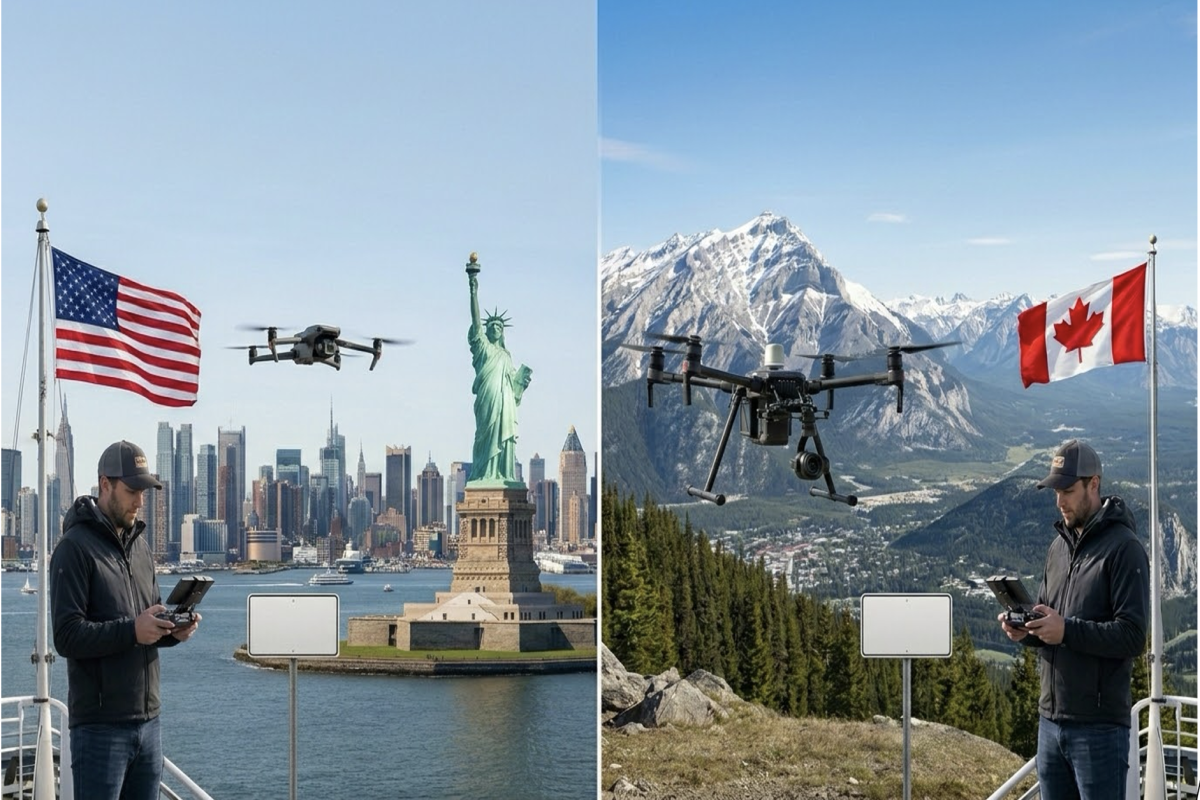
If you live in the United States or Canada, or if you plan to travel across the border with your drone in tow, you might assume the rules of the sky are universal. They aren't. While both nations share the common goals of protecting airspace, preventing accidents, and ensuring privacy, the way they regulate drone pilots is fundamentally different.
Here is a comprehensive breakdown of how drone laws in the United States compare to those in Canada.
The Governing Bodies: FAA vs. Transport Canada
Before diving into the specific rules, it helps to know who is setting them.
In the United States, drone regulations are governed by the Federal Aviation Administration (FAA). The FAA is the undisputed authority over all navigable airspace in the US, from the ground up. Whether you are flying a massive Boeing 747 or a tiny DJI Mini, you answer to the FAA.
In Canada, the airspace is regulated by Transport Canada (TC). Transport Canada establishes the rules for all aviation across the country, aiming to keep both crewed and uncrewed aircraft operating smoothly without endangering the public.
The Core Philosophy: Intent vs. Risk
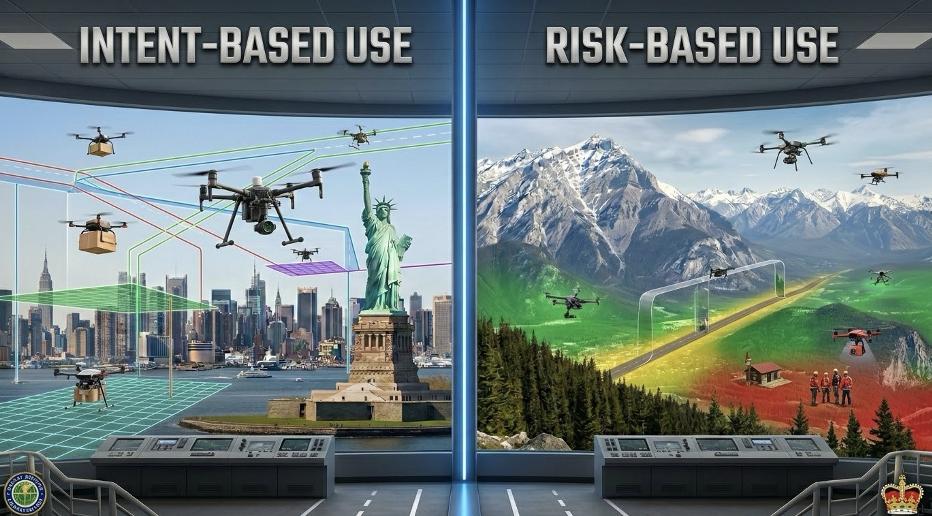
The most fascinating difference between the US and Canada is the foundational philosophy behind their regulations.
The US Model: Intent-Based
The FAA primarily categorizes flights based on why you are flying. Are you flying purely for fun, or are you flying to make money or aid a business?
● Recreational Flyers: If you are flying just for fun, you fall under the Exception for Limited Recreational Operations.
● Commercial Flyers: If your flight is tied to a business, a brand, or financial compensation (even if it's just monetizing a YouTube video or inspecting your own business’s roof), you must operate under Part 107 regulations.
The Canadian Model: Risk-Based
Transport Canada doesn't care if you are a teenager flying for fun or a professional surveying a construction site. They care about the risk your flight poses to people, property, and other aircraft based heavily on the drone's weight and your operating environment. Transport Canada divides standard consumer drone flying into three main categories (with advanced beyond-visual-line-of-sight operations rolling out for complex commercial flights):
● Micro Drones (Under 250g): Very low-risk operations.
● Basic Operations: Drones weighing 250g to 25kg flying in uncontrolled airspace, far away from people.
● Advanced Operations: Drones weighing 250g to 25kg flying in controlled airspace or close to/over people.
Getting Ready to Fly: Registration and Testing
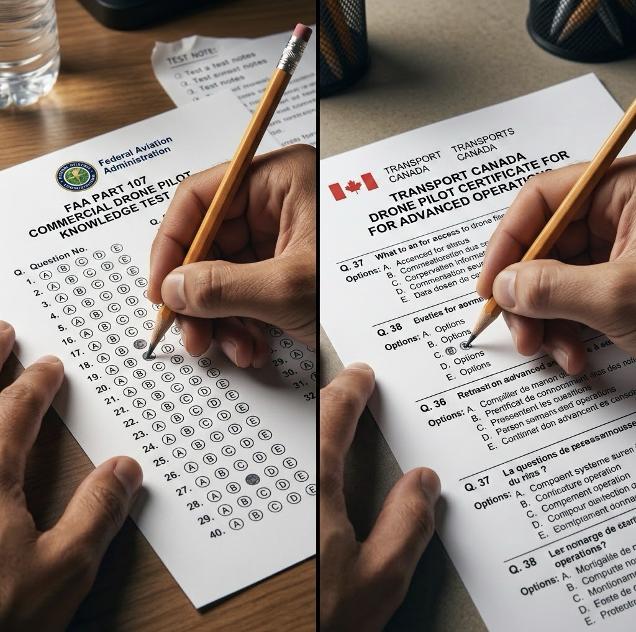
Before your drone even leaves the ground, both countries require some paperwork, but the requirements differ significantly based on the drone's weight and features.
In the United States:
If your drone weighs less than 250 grams (like the DJI Mini series) and you are flying strictly for fun, you do not need to register the drone with the FAA. However, you are still required to pass a free, online aeronautical knowledge test called TRUST (The Recreational UAS Safety Test) and carry proof of passage.
If your drone weighs 250 grams or more, you must register it with the FAA (which costs $5) and mark the registration number on the outside of the aircraft.
If you intend to fly commercially, regardless of the drone’s weight, you must pass the comprehensive in-person Part 107 Commercial Drone License exam, which requires rigorous studying of airspace classifications, weather patterns, and aviation charts. You must also register every drone you use commercially.
In Canada:
Canada treats the weight of the drone as the primary trigger for registration and licensing.
● Micro Drones (under 250g): You do not need to register the drone, and you do not need a pilot certificate. You are simply expected to fly safely and not pose a hazard.
● Drones 250g to 25kg: You must register your drone with Transport Canada (costing $10 CAD as of late 2025 updates) and mark it with the registration number. You must also obtain a Drone Pilot Certificate.
○ For Basic Operations, you must pass an online exam.
○ For Advanced Operations, you must pass a more difficult online exam and complete an in-person flight review with a certified training provider.
The Rules of the Air: Altitude, Line of Sight, and Airspace
Once you are in the air, the US and Canada share several fundamental safety rules. In both countries, you must:
● Keep your drone within your Visual Line of Sight (VLOS) at all times (unless operating under specific complex operational certificates). You cannot fly it behind buildings, into clouds, or so far away that you can no longer see its orientation with your naked eye.
● Stay below a maximum altitude of 400 feet (120-122 meters) from the surface of the earth.
● Never fly near airports, airfields, emergency scenes, or aircraft.
However, when it comes to flying near people and buildings, the rules diverge.
US Flight Rules:
Under Part 107 and recreational rules, you generally cannot fly over human beings or moving vehicles unless you meet strict, complex criteria (categorized by the kinetic energy of the drone and whether it has prop-guards). There are no specific, overarching distance rules regarding how many feet you must stay away from a single building, but you cannot fly in controlled airspace (near airports or major cities) without getting prior authorization through an app-based system called LAANC (Low Altitude Authorization and Notification Capability). Furthermore, national parks, stadiums during sporting events, and emergency response areas are strictly off-limits.
Canadian Flight Rules (Basic and Advanced):
Because Canada uses a risk-based system, your limits depend entirely on your certification:
● Micro Drones: You must avoid flying recklessly near people or in controlled airspace, but there are no strict numerical distance rules (except that you cannot fly them at advertised events without a special certificate).
● Basic Operations: You must remain in uncontrolled airspace. You must stay at least 30 meters (100 feet) horizontally away from bystanders at all times. You cannot fly within 5.6 kilometers (3 nautical miles) of an airport or 1.9 kilometers (1 nautical mile) of a heliport.
● Advanced Operations: With the right certificate and a drone specifically safety-rated by its manufacturer for advanced flights, you are granted far more freedom. You can fly in controlled airspace (with NAV CANADA permission via the NAV Drone app), you can fly within 30 meters of bystanders, and in some cases, you can even fly directly over them.
Remote ID: The Digital License Plate
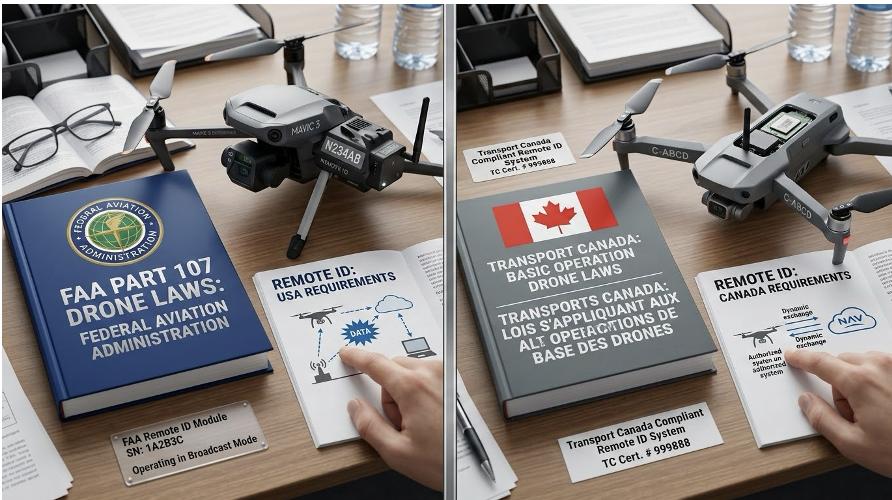
Both nations are grappling with how to track drones in the sky to ensure accountability.
In the US, the FAA has implemented Remote ID. This is essentially a digital license plate. All drones operating in US airspace (with very few exceptions, like flying at specific FAA-recognized identification areas) must broadcast their location, altitude, speed, and the control station's location via Bluetooth or Wi-Fi. Most new drones have this built-in, while older drones require an external broadcast module.
In Canada, Transport Canada is steadily implementing its own Remote ID framework alongside complex and advanced operation standards. While traditional basic flights relied heavily on registration markings, as of 2025/2026, drones manufactured for use in advanced or complex operations must have built-in Remote ID capabilities to meet Safety Assurance declarations. This digital broadcasting is becoming increasingly mandatory to safely integrate drones into busy Canadian airspace.
Fines and Enforcement
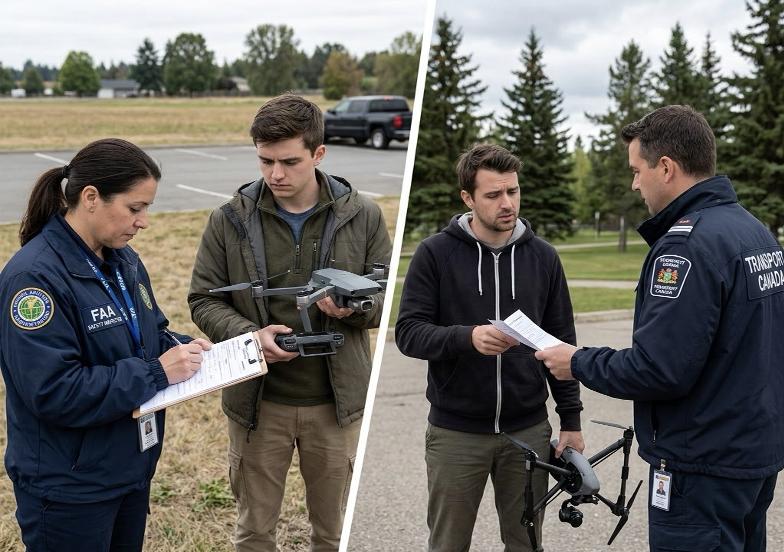
Neither the FAA nor Transport Canada takes rule-breaking lightly.
In the US, the FAA can levy civil penalties of up to $37,736 per violation. Furthermore, local law enforcement can arrest you for reckless endangerment, trespassing, or violating local city ordinances.
In Canada, enforcement is equally rigorous. Transport Canada works alongside local law enforcement to issue fines under the Canadian Aviation Regulations (CARs). Individuals breaking the rules can face fines up to $1,000 for flying without a certificate, $3,000 for flying in unauthorized airspace, and up to $5,000 for flying an unregistered drone. For corporations or businesses, those fines skyrocket to up to $25,000 per violation. Endangering the safety of a manned aircraft can result in massive fines and even prison time.
Summary: Which is Stricter?
So, which country has the stricter drone laws? It depends entirely on what you are trying to do.
If you want to fly a sub-250g drone to make money (e.g., selling real estate photos), the United States is much stricter, requiring a full Part 107 commercial license, whereas Canada allows you to do this with a micro drone without needing any registration or pilot certificate at all, as long as you fly safely.
Conversely, if you are a hobbyist who just bought a standard 500-gram drone to fly for fun on the weekends, Canada is stricter out of the box. You will be required to register the drone and pass a formal Transport Canada aviation exam to get a Basic Operations certificate, and you will be barred from flying within 30 meters of people. In the US, that same hobbyist simply registers the drone, takes a quick, free TRUST safety test, and can start flying under recreational rules.
Ultimately, whether you are flying over the neon lights of Miami or the rugged, majestic peaks of the Canadian Rockies, the core tenet remains the same: the sky is shared. Take the time to study the local aviation laws, respect the privacy of those below, and fly safely. Your drone is a powerful tool for creativity—as long as you keep it on the right side of the law.