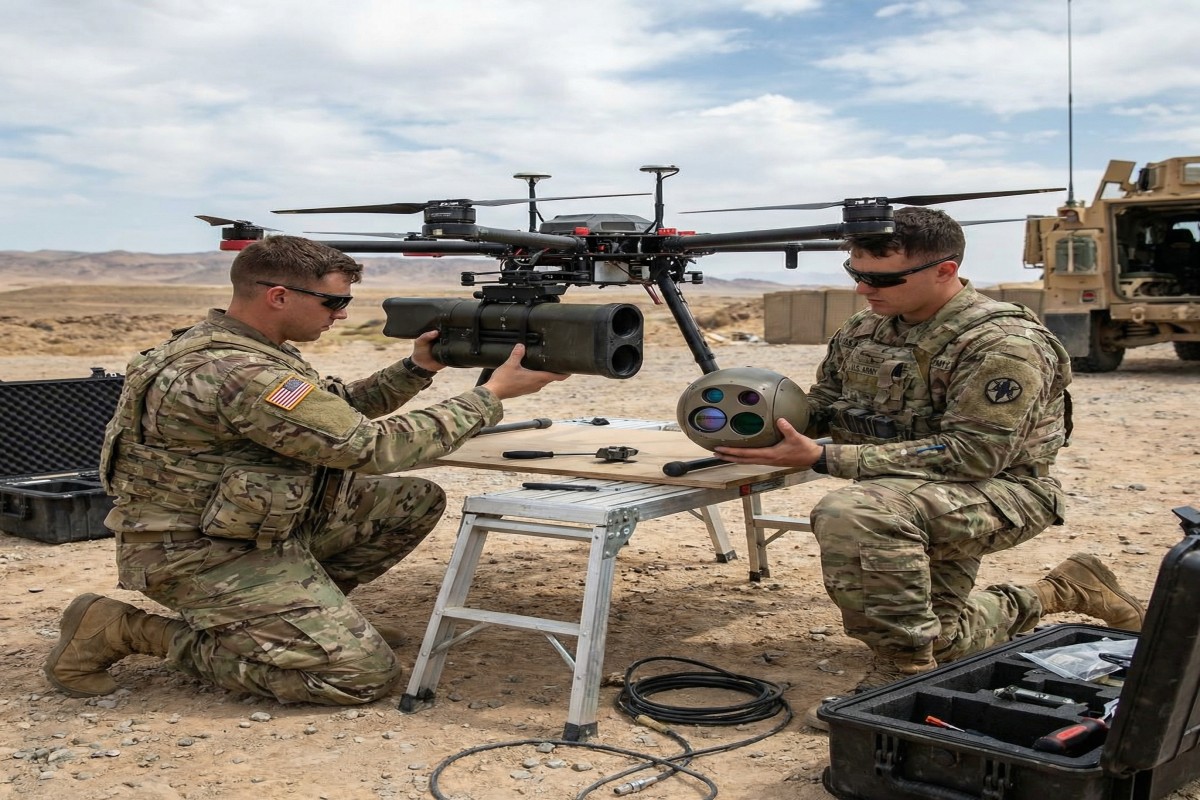

"If whatever a company is building isn't modular with other industry partners to work together, then I'm going to go with another industry partner that is," said Maj. Wolf Amacker of the Army's Unmanned Aircraft Systems and Tactics Branch.
Amacker wants to see drones designed with interchangeable parts, so that hardware and software that can be upgraded—or changed— without replacing the entire system.
"Modularity will give soldiers more flexibility in what weapons they field and how they employ them," he says. "I don't like the approach where a company says, 'This my equipment, and if you want to use it, you just have to use what I give you.' Instead, I want to work with companies that ask, 'Hey, how can we help you make your equipment even more useful and make those modifications with you?'"
Maj. Rachel Martin, the director of the Army's Unmanned Advanced Lethality Course, also sees drone tactics and technology evolving quickly.
"The best industry partners are the ones that actively listen to soldiers," she says. "They observe training, absorb lessons, and adjust their systems to support what soldiers actually need."
The war in Ukraine is an opportunity for strategic study, as Ukrainian soldiers have pushed for flexible drone systems that can be easily modified for different missions—even to the point of swapping out parts themselves.
In fact, CEOs such as Gediminas Guoba of Lithuanian drone company Granta Autonomy—which has provided drones to Ukraine—maintains systems can't be designed for this year or the next. They need to be updated for the future. Guoba says the software in drones sent to Ukraine changes every month.
More and more, as development cycles for combat drones are being reduced to weeks, instead of months or years, viable systems can't be designed exclusively for single missions. Soldiers need to customize drones based on the actions they need to take and traditional "monolithic" designs may not cut it on the battlefield any more.